
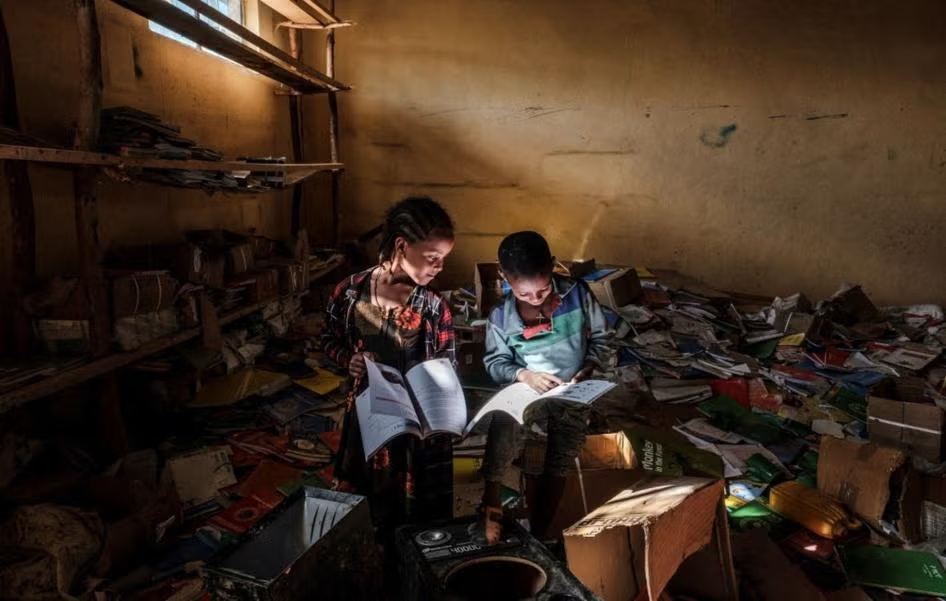
Ethiopia’s armed conflicts have received sustained attention on the battlefield and in political negotiations. What is happening in classrooms has received far less. That may be a mistake. The educational damage of conflict can last much longer than the fighting itself.
The scale of the disruption is difficult to ignore. UNICEF reported that 4.4 million children in Amhara did not attend school during the 2024/25 academic year, the highest number in the country. Nearly 3,600 schools were closed for security reasons7. In Tigray, an estimated 1.4 million children were out of school by early 2021, while around a quarter of the region’s schools had been disrupted, including through their use as military bases2,3.
4.4 million
Children in Amhara reportedly did not attend school during the 2024/25 academic year.
~3,600
Schools closed for security reasons.
These are not simply interruptions to a timetable. They represent lost instruction, displacement, damaged records, weakened institutions, and years in which children are unable to build the knowledge and skills they need.
The consequences are also personal. Qualitative research from South Gondar describes adolescents whose education was disrupted by recruitment into armed forces or Fano, destroyed school infrastructure and records, and trauma that made concentration nearly impossible. Some boys described military participation as the only option left, while education became “the least thing to worry about”5.
Teachers and communities have also paid a price. When schools are damaged or occupied, teachers may be displaced, leave for the front, or work without the resources and support needed to teach effectively. A school can reopen on paper while remaining unable to provide stable, meaningful learning.
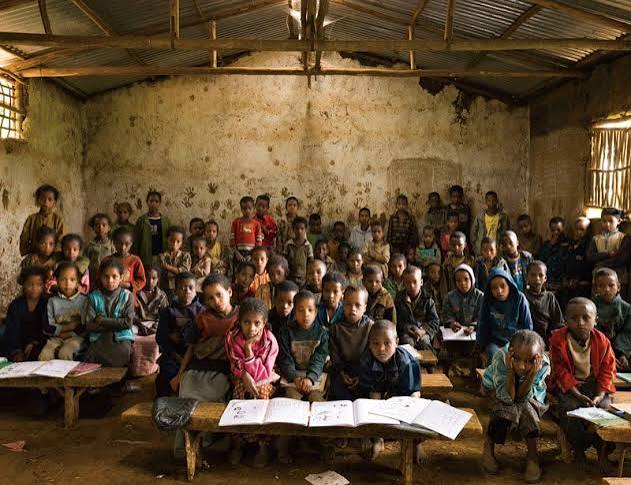
“Reopening a school does not automatically restore the learning that was lost.”
The longer-term risks are substantial. Evidence from Ethiopia’s earlier war with Eritrea links conflict exposure to lower mathematics and language achievement a decade later, more grade repetition, and higher dropout8. The current generation of affected students may therefore face consequences well beyond the immediate period of insecurity. Some will lose years of education. Others may never return. The country may eventually feel those losses through a smaller pipeline of teachers, health workers, engineers, and other skilled professionals.
The direct pathway
Armed conflict leads to insecurity, school destruction, displacement, recruitment, interrupted learning, and trauma. Those disruptions produce educational losses, which can become human-capital losses over time.
- 01Armed conflict
- 02Insecurity · school destruction · displacement · recruitment · trauma
- 03Interrupted education
- 04Learning loss
- 05Long-term human-capital effects
The harder question is fiscal.
Conflict places pressure on public finances. Governments must respond to insecurity, displacement, humanitarian needs, and damaged infrastructure, often while revenues and administrative capacity are already under strain. Local researchers in South Gondar reported education budgets being diverted toward the war effort and teachers leaving for the front without replacement5. That is important evidence of what happened in one conflict-affected setting. It is not, by itself, proof of a deliberate national decision by Ethiopia’s federal government to move funds from education to the military.
Cross-country research covering 44 sub-Saharan African countries finds that military spending can crowd out education spending in eastern Africa, the sub-region that includes Ethiopia6. But regional econometric evidence is not Ethiopian federal budget evidence. Association is not proof of causation. If military expenditure rises while education outcomes deteriorate, the two trends may be connected, but the pattern alone does not establish why. War-related fiscal strain, inflation, falling revenues, administrative weakness, and long-standing problems in education financing could all be part of the explanation.
“We don’t know yet. That deserves a public expenditure review, not an assumption.”
- 01Conflict and security demands
- 02Fiscal pressure
- 03Possible competition for public resources
- 04Education and other civilian investment
- 05Potential human-capital consequences
What the evidence tells us
- Conflict has closed and damaged schools.
- Students have experienced displacement and interrupted learning.
- Educators and education systems have faced severe disruption.
- Prolonged educational interruption can have consequences beyond the immediate conflict period.
What still needs to be established
- The extent to which military or security expenditure displaced education spending nationally.
- The relative role of inflation, fiscal pressure, revenue constraints and intentional reprioritization.
- Differences between federal and regional expenditure patterns.
What should happen now?
The distinction between the direct and indirect pathways should shape the policy response. The evidence for direct conflict damage is already strong enough to justify action2,3. The fiscal question requires a different kind of response: transparent analysis of how conflict-related spending has affected education and other civilian investments at federal and regional levels — examining budgets, execution rates, off-budget expenditure, teacher recruitment and retention, and changes in school construction and maintenance5,6.
- 01
Protect schools from military use
Keep education facilities out of the conflict.
- 02
Restore damaged educational infrastructure
Repair and reopen schools affected by fighting.
- 03
Replace lost educational records and materials
Reconstruct student records, certificates and teaching resources.
- 04
Address learning loss, not merely school reopening
Students who missed months or years of instruction need targeted catch-up support.
- 05
Support teachers and the education workforce
Safe working conditions, timely salaries, professional support and practical help returning to classrooms.
- 06
Protect examination continuity
Students' futures should not depend on whether they lived in a conflict-affected area.
- 07
Conduct transparent analysis of conflict-related fiscal trade-offs
A public expenditure review distinguishing intentional reprioritization from broader economic crisis.
This is not a call for artificial neutrality. If credible evidence shows that public institutions failed to protect schools, that armed groups recruited students, or that authorities allowed education systems to deteriorate, those failures should be named. The same standard must apply to every actor. Independence means not assigning motives or responsibility beyond what the evidence can support.
The immediate priority is clear even before every fiscal question is settled: keep schools safe, restore the education workforce, support affected students, and protect the continuity of secondary education. Examination systems also need attention so that students’ futures do not depend on whether they happened to live in an area affected by conflict1. In post-war Tigray, research on primary school English teachers points to the importance of supporting the education workforce as schools attempt to resume their work4.
Human capital is often discussed in abstract terms. In practice, it is a child who misses school, a teacher who leaves the profession, or a student who reaches an examination after years of interrupted learning.
Ethiopia’s future capacity will be shaped by how many of those young people are able to return, learn, and continue.